
Niles represents an attempt to turn nearly 25 years of accumulated brand weirdness into intellectual property of its own, and there may be few brands better suited to pulling it off.
There is now a six-foot crocodile working at Crocs headquarters, which, when you think about it, feels less like a marketing stunt and more like the resolution of a plotline that began sometime around 2002. His name is Niles, he is apparently optimistic, adventurous and sufficiently employable to appear alongside actual Crocs employees in a new workplace micro-series, and he has spent the past quarter-century hiding in plain sight as the tiny crocodile silhouette embedded in the brand’s footwear.
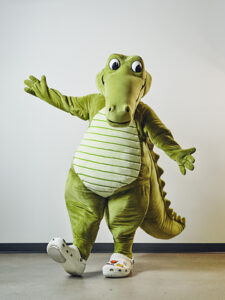 This is the sort of thing that could become unbearably twee in the hands of almost any other company, but Crocs has spent years developing one of marketing’s most valuable superpowers: the ability to be ridiculous without appearing embarrassed about it. The company that turned a foam clog once treated as shorthand for questionable taste into a global fashion object has learned that cultural relevance does not always come from making people admire you; sometimes it comes from giving people something they genuinely enjoy having around.
Niles is the logical, if wonderfully strange, extension of that philosophy, because Crocs isn’t simply introducing a mascot so much as excavating one from its own history. The crocodile has been part of the product since the company’s earliest days, and rather than commissioning a focus group to invent some scientifically optimized blob with enormous eyes and a suspiciously detailed personality bible, Crocs has taken something consumers have already encountered millions of times and asked a delightfully simple question: what if this little guy were alive?
From Rivet to Resident
There is a clever piece of brand architecture buried underneath the silliness, because Niles isn’t being positioned as the smiling creature who occasionally appears next to the logo at sporting events. Crocs says it has developed him more like a sitcom character, complete with interests, flaws, ambitions and a personality capable of evolving over time, while his first adventures will unfold through weekly social episodes showing him attempting to navigate office life at Crocs headquarters.
 That distinction matters because traditional mascots are generally symbols, while characters can become intellectual property. Tony the Tiger exists largely to sell cereal and the GEICO Gecko exists to sell insurance, but characters with sufficiently developed personalities can eventually generate attention independent of whatever originally created them, giving brands something increasingly difficult to manufacture through conventional advertising: an audience that voluntarily wonders what happens next.
Crocs is explicit about that ambition, describing Niles as a long-term investment in scalable intellectual property capable of moving through content, experiences, entertainment and future brand extensions. That is corporate language for something considerably more interesting, which is the possibility that Niles eventually becomes valuable not because he advertises Crocs, but because people actually like Niles.
Crocs Has Earned the Right to Be Weird
The timing also makes sense within the larger evolution of the brand, particularly after Crocs introduced its “Wonderfully Unordinary” global platform earlier this year as the successor to the long-running “Come As You Are” positioning. That platform is built around individuality, instinct, creativity and resistance to cultural sameness, making the arrival of an enormous anthropomorphic crocodile with an office job feel surprisingly coherent rather than random.
 More importantly, Crocs already understands that consumers want to participate in its brand rather than merely purchase it. Jibbitz turned the shoe itself into a tiny personal billboard, collaborations have repeatedly allowed Crocs to wander through entertainment and fandom, and the company’s licensed character universe already stretches across Disney, Marvel, Pokémon, Star Wars, DC, Harry Potter and others.
Niles reverses that equation in an intriguing way, because instead of Crocs borrowing somebody else’s characters to make its products culturally interesting, Crocs is attempting to create a character that belongs entirely to Crocs. After years of putting other people’s intellectual property onto its shoes, the company is beginning to ask whether its own universe might contain intellectual property worth developing.
That is a considerably bigger idea than a mascot.
The Egg Came First
Even Niles’ arrival demonstrates that Crocs understands the difference between announcing something and allowing people to discover it, with the company planting a mysterious three-foot egg in TikTok Shop livestreams and hiding it within digital brand assets before staging a 24-hour countdown to its eventual social-media hatching. None of this was necessary to introduce a crocodile, of course, but necessity has never been particularly important to good brand theater.
The egg created a tiny mystery, the mystery created curiosity and the hatching transformed a corporate announcement into an event, however absurdly small that event might seem against everything else happening in the world. This is increasingly what strong social-first marketing understands: audiences don’t necessarily want another campaign explained to them, but they are remarkably willing to investigate something strange appearing in the corner of the screen.
There is also something refreshing about a company investing in a character at precisely the moment marketing is becoming obsessed with synthetic efficiency. Generative systems can produce infinite social posts, infinite variations and infinite perfectly serviceable brand content, which means distinctiveness increasingly comes from creating things audiences can recognize, remember and perhaps even care about.
Niles is deliberately inefficient in that sense, because characters require continuity, writing, personality, world-building and patience. Crocs cannot simply optimize him into existence; it has to make him interesting.
The Hard Part Comes After Hatching
Of course, creating a mascot is easy compared with creating a character people actually want to spend time with, and this is where Niles either becomes a genuinely interesting piece of brand IP or another anthropomorphic corporate employee quietly retired after eighteen months. Crocs will have to resist the temptation to make every Niles story about Crocs, because the quickest way to kill a character is to remind audiences constantly that he exists to move merchandise.
If Niles is going to work, he needs permission to be weird, occasionally useless and perhaps even mildly rebellious, because memorable characters have edges while corporate mascots usually have approval processes. The fact that Crocs says he has flaws and ambitions is therefore more important than it initially sounds, because the company’s willingness to let those characteristics become genuinely entertaining will determine whether Niles develops a life beyond the marketing calendar.
There are obvious commercial possibilities if he does, ranging from Niles Jibbitz and plush toys to appearances, collaborations, animated content and perhaps eventually entertainment properties that barely involve footwear at all. Yet the more interesting opportunity is emotional rather than transactional, because a character gives Crocs a persistent protagonist through whom the brand can experience culture instead of constantly commenting on it from the corporate sidelines.
That could prove particularly useful as Crocs approaches its 25th anniversary in 2027, when nostalgia for the brand’s unlikely journey will inevitably collide with the need to make Crocs meaningful to another generation of consumers. Niles connects those two things rather neatly: he is simultaneously something that has supposedly been there since the beginning and something completely new.
A Crocodile With Somewhere to Go
Perhaps the most charming thing about Niles is that Crocs did not need him, because the brand already possesses an instantly recognizable product silhouette, enormous cultural visibility and a personalization system that effectively turns millions of consumers into co-designers. This is not a desperate attempt to invent an identity for a brand nobody understands, but rather an attempt to expand a brand universe that consumers already recognize almost instantly.
Instead, Niles feels like something brands rarely give themselves permission to create anymore: a long-term creative asset whose precise return cannot be completely known at launch. He might sell shoes, he might become a social character, he might become merchandise, he might become entertainment IP, or he might simply become the strange green crocodile who occasionally turns up somewhere and makes Crocs feel a little more human.
And perhaps that is exactly why he has a chance.
Crocs has spent nearly 25 years demonstrating that objects don’t have to be conventionally beautiful to become beloved, that fashion doesn’t always have to take itself seriously and that being unmistakable is often considerably more valuable than being tasteful. Giving the tiny crocodile on the side of the shoe a name, a personality and six feet of vertical ambition feels completely consistent with that history, because Niles isn’t really introducing something foreign into the Crocs universe.
He was apparently living there all along.
Photos by Crocs