
In a world where every brand is rushing to embrace AI, Polaroid has done something far more creative: it has made the case for being unapologetically human.
There is an unwritten rule in modern marketing that says brands should never argue with the direction technology is moving. The safest strategy is usually to embrace the next platform, celebrate the latest innovation and convince consumers that whatever comes next is unquestionably better than what came before. It is a formula that has shaped everything from smartphone launches to AI-powered software, and it has conditioned marketers to believe that progress itself is the message.
That is precisely why Polaroid’s latest global campaign feels so refreshing.
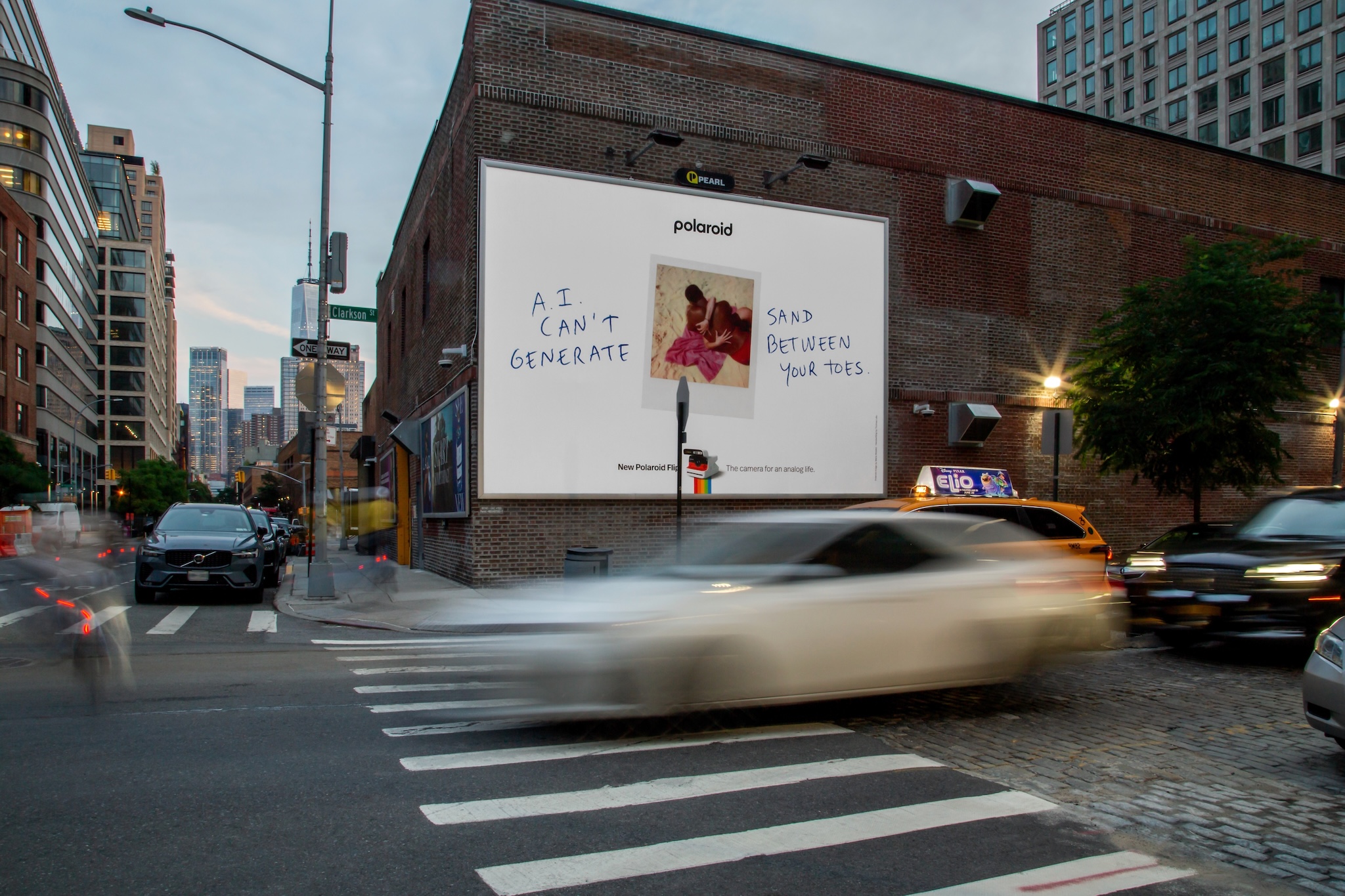
Instead of promising a smarter camera, more intelligent software or another AI-powered feature, the company has built an entire campaign around the radical proposition that perhaps we have enough technology already. Through a series of beautifully understated outdoor executions featuring headlines such as “No one on their deathbed ever said: I wish I’d spent more time on my phone,” “Real stories. Not stories & reels,” and “AI can’t generate the sand between your toes,” Polaroid isn’t simply advertising a camera. It is defending an entire philosophy of living. (Polaroid Newsroom)
That distinction matters because the campaign succeeds for a reason that extends far beyond clever copywriting. It understands that the strongest brands rarely compete by adding features. They compete by giving people something to believe.
For years, marketers have spoken about authenticity as though it were another channel strategy or creative format. Authenticity became a buzzword that appeared in conference presentations, agency decks and brand guidelines while becoming increasingly difficult to identify in the real world. Consumers have spent the past several years watching AI generate images, write copy, produce music, clone voices and create influencers who never existed, all while social media algorithms have continued rewarding performance over presence. Against that backdrop, Polaroid has recognised an opportunity that most technology companies simply cannot own.
Its competitive advantage is reality itself.

That is an extraordinary piece of brand positioning because it reframes the conversation away from cameras entirely. A Polaroid photograph is not objectively sharper than a smartphone image. It is not easier to share. It lacks computational photography, cloud backup and virtually every convenience consumers have come to expect. Judged as a piece of technology, it loses almost every comparison.
Judged as an emotional artifact, however, it becomes almost impossible to replace.
That is the insight sitting underneath this campaign. Polaroid understands that people are becoming increasingly suspicious of perfectly curated digital experiences precisely because perfection has become so easy to manufacture. The imperfections of instant photography, from soft focus and unpredictable lighting to fingerprints, faded colours and accidental overexposure, have become signals of authenticity rather than technical flaws. In an AI era where almost anything can be generated, the imperfections become the proof that something actually happened.
The creative execution reinforces that idea brilliantly. Rather than shouting louder than every other advertiser, Polaroid relies on restraint. The photography feels human rather than polished. The typography resembles handwritten notes. The copy is provocative without becoming self-righteous, and the media placement demonstrates an almost mischievous understanding of context. Billboards positioned outside Apple Stores, beside Google offices and in major transport hubs transform ordinary outdoor advertising into cultural commentary, inviting people to question not simply their phones but their relationship with technology itself.
Even the experiential component reflects the same discipline. Phone-free walking tours in cities including Paris, Tokyo and London asked participants to lock away their smartphones for an hour and explore their surroundings using the new Polaroid Flip before mailing one of their photographs as a physical postcard. It would have been easy to build another influencer activation designed primarily for social content. Instead, Polaroid created an experience that could not fully exist online because its value depended on people looking away from their screens.
What makes this campaign particularly impressive is that it avoids the trap that many purpose-driven campaigns fall into. It is not scolding consumers for using technology, nor is it pretending digital life should disappear altogether. Creative Director Patricia Varella has been careful to explain that Polaroid is not anti-digital but unapologetically pro-human, a subtle distinction that gives the work credibility instead of turning it into nostalgia for nostalgia’s sake.
There is a much bigger lesson here for marketers. As artificial intelligence rapidly becomes table stakes across industries, competitive differentiation will become increasingly difficult to achieve through technology alone. AI capabilities will spread. Automation will become expected. Productivity gains will eventually become commodities. When every company has access to similar models, similar tools and similar efficiencies, the brands that stand apart will not necessarily be the ones using the most AI. They will be the ones that articulate the clearest philosophy about why they exist.
Polaroid has answered that question with remarkable confidence. It no longer exists to compete with smartphone cameras because that battle was effectively over years ago. Instead, it exists to protect something that smartphones accidentally eroded: the value of slowing down, paying attention and creating physical memories that cannot be endlessly edited, filtered or regenerated.
There is an irony at the heart of all this. For decades, marketers obsessed over making brands feel more technological because technology represented the future. Polaroid has recognised that the future consumers increasingly crave may actually feel more tactile, more imperfect and more human than the digital world surrounding them. That does not make this an anti-AI campaign. It makes it an emphatically pro-human one, and that may prove to be one of the smartest creative positions any brand has taken this year.
The best marketing has always reflected culture rather than simply following it. Polaroid’s campaign does exactly that by recognising a quiet shift taking place beneath the surface of consumer behaviour. People are not rejecting technology, but they are becoming increasingly protective of the moments where technology disappears. Brands that understand that distinction will build stronger emotional connections than those still competing to demonstrate who has the most advanced algorithms.
In an industry that often mistakes innovation for originality, Polaroid has reminded marketers that sometimes the bravest creative decision is not inventing the future. Sometimes it is defending the parts of being human that are worth carrying into it.